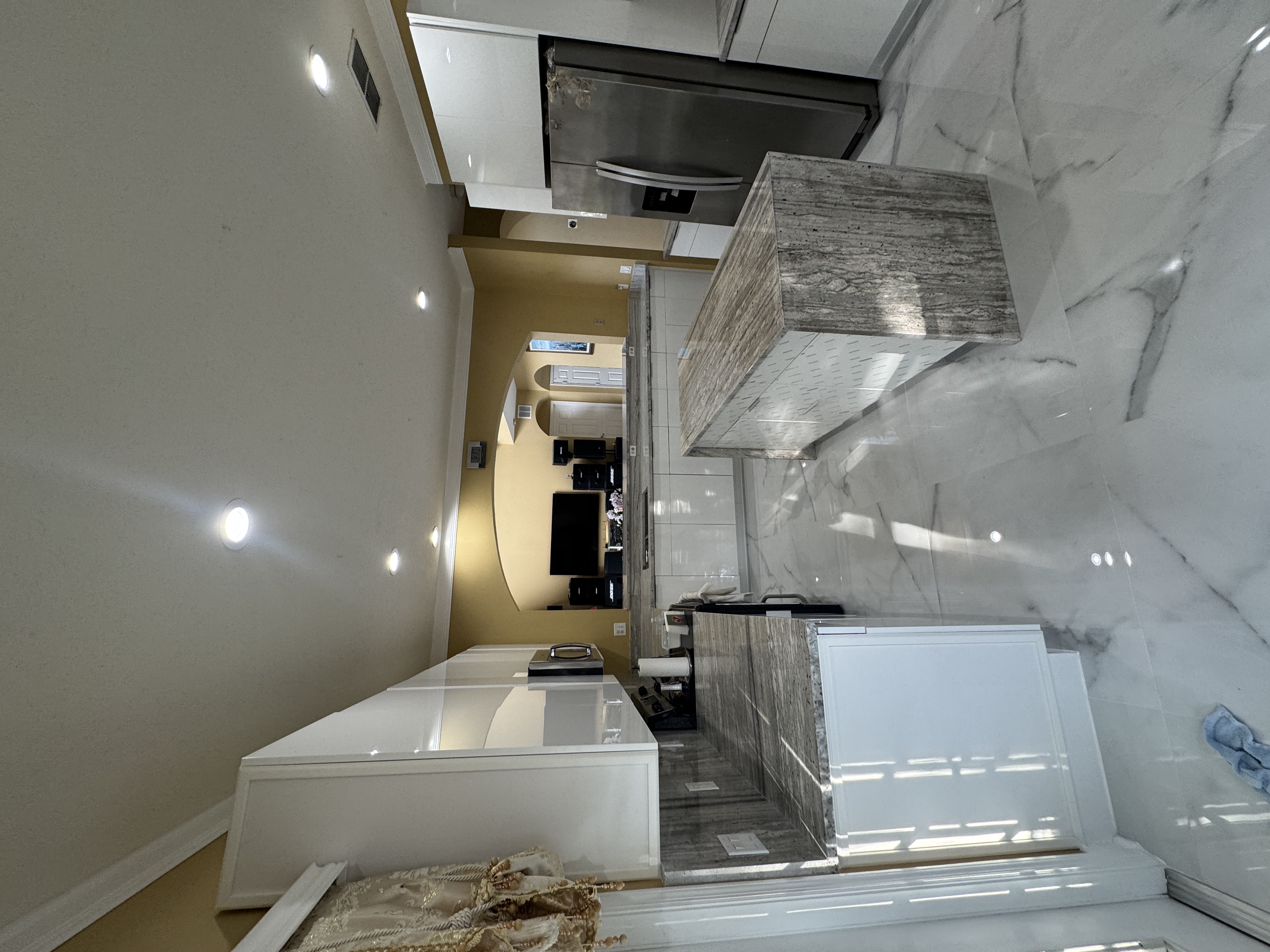
Granite sealing is often reduced to one rule: seal your countertops
every year. The reality is more nuanced. Learn what sealer actually
does, why different granites absorb liquids differently and how to
evaluate whether your countertop may benefit from sealing.
Some granite countertops benefit from sealing, but not every
granite needs to be sealed on the same schedule. Granite is
natural stone, and absorption can vary between varieties. The stone,
finish, existing treatment, sealer used and countertop conditions all
matter.
01 — The Answer
Does Granite Actually Need to Be Sealed?
Many granite countertops can benefit from an appropriate
penetrating or impregnating stone sealer, particularly when the
stone readily absorbs liquids.
But granite is not one uniform material.
Different granite varieties can have different mineral structures,
absorption characteristics and finishes. Some may absorb liquids
more readily than others.
That means the better question is not simply:
"Does granite need sealer?"
It is:
"Does this particular granite countertop currently benefit
from sealing?"
Common Rule
"Seal all granite every year."
This is easy to remember, but it treats every granite,
installation and sealer as though they behave identically.
Better Approach
Evaluate the Actual Countertop
Consider the stone's absorption, finish, existing treatment,
countertop use and the instructions for the specific sealer
being used.
02 — Natural Variation
Why One Granite Countertop Can Behave Differently From Another
Granite is a natural material rather than a factory-produced surface
with identical composition from one slab to another.
Natural stone sold within the broad granite category can vary in
mineral composition, structure and absorption.
Other factors can also affect countertop behavior, including:
The specific stone
Surface finish
Previous sealing treatments
Cleaning products used over time
Countertop use and exposure
The sealer product previously applied
This is why sealing recommendations should be based on the actual
material rather than countertop color alone.
03 — Understanding Sealer
What Does Granite Sealer Actually Do?
A penetrating or impregnating stone sealer is designed to enter
receptive pores within the stone and help reduce the rate at which
certain liquids are absorbed.
Important Distinction
Sealer Helps Manage Absorption. It Does Not Make Granite
Invincible.
Sealing is not the same as covering granite with a
waterproof shell. A properly selected penetrating sealer
is generally intended to work within the stone rather than create
a thick visible coating on top.
Reducing absorption can provide additional time to clean certain
spills before they penetrate more deeply into an absorbent stone.
But sealer should not be expected to prevent every possible stain,
scratch, chip, chemical reaction or other form of damage.
Understanding Protection
What Granite Sealer Does — and Doesn't Do
Knowing the limits of a sealer helps homeowners care for natural
stone more realistically.
Sealer Can Help
Reduce Liquid Absorption
Slow absorption in receptive stone
Provide more time to clean certain spills
Help reduce some staining risk when appropriately selected and
applied
Work below the surface when using an appropriate penetrating
product
Sealer Does Not
Make Granite Damage-Proof
Make every granite completely stain-proof
Prevent scratches or chips
Replace normal cleaning
Eliminate the need to wipe spills
Make the surface universally chemical-proof
?
04 — Sealing Frequency
How Often Should Granite Be Sealed?
There is no universal calendar interval that applies to every
granite countertop.
Recommendations such as "once a year" may be easy to remember, but
the actual need can vary.
Resealing frequency can be influenced by:
Stone absorption
Surface finish
Type and quality of sealer
How the sealer was applied
Cleaning practices
Countertop use
Existing treatment
Instead of applying more sealer simply because a date arrived,
evaluate the actual countertop and follow the instructions for the
sealer product being used.
05 — Evaluating the Countertop
How Can You Tell Whether Granite Is Absorbing Liquid?
One simple homeowner observation sometimes used to evaluate an
uncoated natural stone surface is to see how the stone reacts to a
small amount of water.
This is not a laboratory porosity test, and it should not override
the instructions of the stone supplier, fabricator or sealer
manufacturer.
It can, however, help demonstrate the basic difference between
water sitting on the surface and water being absorbed into the
stone.
06 — Simple Observation
A Basic Water-Drop Observation
If you know the surface is an appropriate uncoated natural stone,
you can observe how a small, inconspicuous area responds to clean
water.
01
Choose a Small Area
Use a clean, inconspicuous portion of the countertop.
02
Add Clean Water
Place a small amount of water on the surface rather than
flooding the countertop.
03
Observe
Watch whether the water remains beaded on top or the stone
begins to darken beneath it.
04
Wipe & Let Dry
Remove the water and allow any temporary moisture darkening to
dry completely.
If the stone darkens as moisture enters it, that indicates the
surface is absorbing water in that area.
If water remains on the surface without visible absorption, that
observation alone does not prove what treatment is present or that
the countertop will never require maintenance.
Don't Use This Test on an Unknown Surface
First identify the countertop. Engineered quartz, coated
surfaces, marble, quartzite and other materials have different
characteristics. A homeowner should not assume that every
stone-looking surface is granite.
Natural stone appearance alone does not tell you its absorption
rate or current sealing condition.
07 — Applying Sealer
How Is Granite Sealer Applied?
Application instructions vary by sealer, so the product
manufacturer's directions should control the process.
In general, an appropriate penetrating stone sealer is applied to a
clean surface and given the opportunity to interact with receptive
areas of the stone.
Excess product should not simply be left on the countertop unless
the product instructions specifically require it.
Improper application or leaving excess product on the surface can
cause haze, streaks or residue depending on the sealer.
Before using any sealer:
Confirm the countertop material
Confirm the product is appropriate for that stone and finish
Read the manufacturer's instructions
Make sure the surface meets the product's preparation
requirements
Test in an inconspicuous area when directed
Follow application, dwell-time, excess-removal and curing
instructions
08 — More Is Not Always Better
Can You Apply Too Much Granite Sealer?
Applying sealer unnecessarily does not automatically provide better
protection.
If the stone is not receptive to additional product, excess sealer
may remain at or near the surface rather than penetrating as
intended.
Depending on the product and application, this can contribute to
residue, streaking, haze or other appearance issues.
Sealing Is Maintenance, Not a Competition
The goal is not to apply as much sealer as possible. The goal is
to use the correct product, when appropriate, according to its
directions and the needs of the actual stone.
09 — Common Mistakes
Granite Sealing Mistakes to Avoid
Assuming every granite needs sealing on the same schedule
Applying a product before identifying the countertop material
Using a sealer that is not intended for the specific stone or
finish
Treating sealer as a substitute for cleaning spills
Assuming sealed granite is completely stain-proof
Leaving excess sealer on the surface contrary to product
instructions
Applying additional sealer simply because a calendar date has
arrived
Using countertop color as the only indicator of sealing needs
10 — Everyday Granite Care
Sealing Is Only One Part of Granite Maintenance
Even appropriately sealed granite still benefits from normal
countertop care.
Helpful habits include:
Wiping spills promptly
Using cleaners appropriate for natural stone
Avoiding unnecessary harsh or abrasive products
Using cutting boards
Using trivets or heat protection as a practical precaution
Following care recommendations for the specific stone and finish
Engineered quartz and granite are different countertop materials.
Engineered quartz is generally nonporous and normally does not
require the routine penetrating sealers commonly associated with
some natural stone surfaces.
Applying a natural-stone sealer to engineered quartz without
manufacturer direction is not a substitute for following the
product's actual care instructions.
Common questions homeowners have about sealing granite
countertops.
Does granite need to be sealed?
Some granite countertops benefit from penetrating sealer, while
others absorb very little. The need depends on the actual stone,
finish, existing treatment and use.
How often should granite be sealed?
There is no single interval that applies to every granite
countertop. Stone absorption, sealer performance, finish,
cleaning practices and countertop use can all affect when
resealing may be appropriate.
What does granite sealer do?
An appropriate penetrating sealer can reduce the rate at which
certain liquids enter receptive stone, providing additional time
for spill cleanup.
Does sealer make granite waterproof?
No. Penetrating sealers generally reduce absorption rather than
creating an impermeable waterproof coating over the countertop.
Can granite be over-sealed?
Applying unnecessary product or failing to remove excess sealer
according to its directions can create residue or appearance
problems.
Does dark granite always need less sealer?
Color alone is not a reliable way to determine sealing needs.
Evaluate the specific stone and its absorption characteristics.
Keep Learning
More Countertop Guides
Continue through the Big Stone Countertop Learning Center.
Big Stone Granite & Design provides granite, quartz, quartzite and
marble countertop fabrication and installation for kitchens and
bathrooms throughout Central Florida and surrounding areas.